Volcano
Mount Fuji: 4 Live Cameras in Japan
Three agencies point four cameras at Mount Fuji from four directions — three from Shizuoka, one from Yamanashi. Same mountain, completely different snow and cloud.
What you can see
This site carries four cameras on Mount Fuji. The awkward part is that they are split between Shizuoka and Yamanashi, so neither prefecture page has the full set. Hence this page.
All four were installed for different reasons. The Meteorological Agency camera watches it as a volcano, keeping an eye on the summit vents. Lake Tanuki is an Environment Ministry scenery camera, taking the mountain head-on from the west-southwest across water. The Fuji Northern Foot flux observation site sits at a forestry research station on the Yamanashi side and looks up from the northern skirt. The erosion-control camera belongs to the transport ministry and faces Osawa-kuzure, where the mountainside is actively collapsing.
Open all four on the same day and you will often find cloud on one side only. Fuji stands alone and manufactures its own cloud, so 'not visible' usually is not the weather — it is just that face brewing its own.
Cameras you can watch now: 4
All 4 are still images. Tap one to open it in the camera list.
-
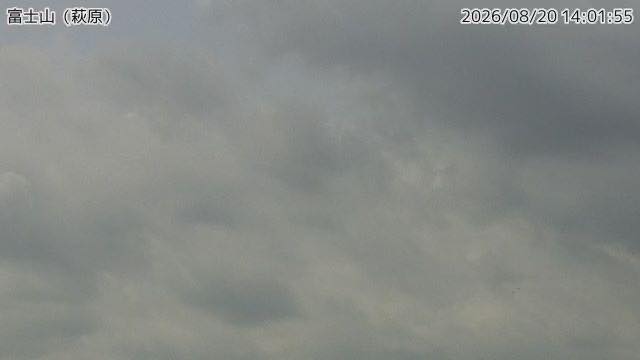 Sample August 2026
Mount Fuji (JMA camera)
Shizuoka / Yamanashi border · Volcano · Nature
This site also carries the ministry's erosion-control cameras on Fuji; this one was placed by the Meteorological Agency to watch the volcano. Different purpose, different aim.
-
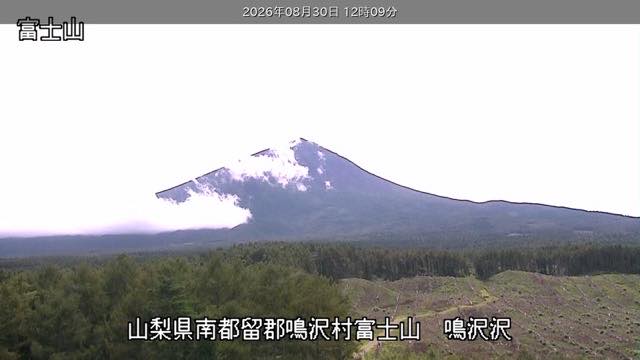 Sample August 2026
Mount Fuji erosion-control cameras
Fuji, Shizuoka · Volcano · Nature
Cameras watching the slopes of Fuji, including the Osawa landslide scar. Not built for sightseeing, which is exactly why the mountain looks unstaged.
-
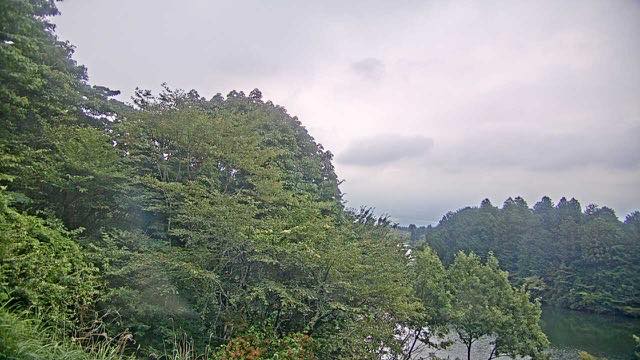 Sample August 2026
Mount Fuji from Lake Tanuki
Fujinomiya, Shizuoka · Nature
The classic head-on view of Fuji across the water. On a windless morning the whole mountain is mirrored in the lake.
-
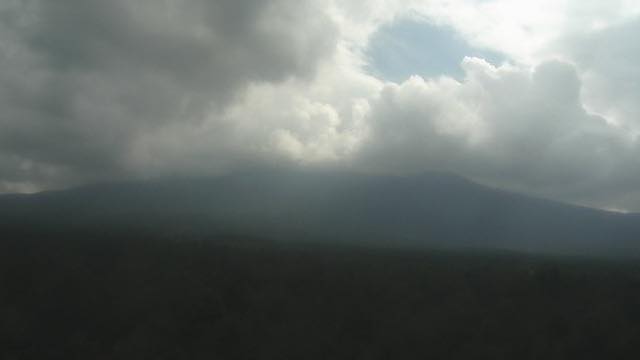 Sample August 2026
Mount Fuji from the northern flux site
Fujiyoshida, Yamanashi · Nature
A camera at a research site measuring how much carbon dioxide the forest takes up. Fuji through the trees — not the postcard composition.
When to watch
A winter morning is the safest bet. From November through February the air is dry enough to give a hard outline, and the snow cap separates the mountain cleanly from the sky. Summer is the opposite: through July and August it is often hidden even in the morning, and the question becomes whether you can make out lights on the climbing routes.
For time of day, aim between sunrise and about 9 a.m. As the air warms, updraughts run up the slopes and build cloud, which is usually there by early afternoon. It sometimes clears again towards evening, and the mountain can turn red just before sunset.
The Lake Tanuki camera sits at the spot known for Diamond Fuji, when the sun rises directly off the summit around the 20th of April and August. The camera only refreshes hourly, though, so catching the moment is luck. The inverted reflection on a windless morning is far easier to plan for.
If it isn't showing
All four are stills, and none shows anything at night. The debris-flow camera is not there for the view, so it leans towards the gullies on the flank rather than the mountain itself, and the northern flux-site camera is for research with trees in the foreground. The one composed picture of the four is Lake Tanuki.
Three of the four sit in Shizuoka and one in Yamanashi. Neither prefecture page carries all four, so this is the only place the different sides can be compared.
Fuji stands alone and makes its own cloud. One camera can be inside it while the camera on the far side is in clear air, so before deciding it is not visible today, open all four in turn. Three of the four are also listed under First Snowcap.
Where to find Mount Fuji
Agencies publishing the cameras on this page
- Japan Meteorological Agency — volcano surveillance cameras (PDL 1.0) — Official site
- Ministry of Land, Infrastructure, Transport and Tourism (PDL 1.0) — Official site
- Ministry of the Environment — Internet Nature Institute (PDL 1.0) — Official site
The footage belongs to each agency. This site is an unofficial guide, and each sample frame was copied once per camera under that agency's terms of use.