Kyoto
Kyoto live cameras: how busy it is
Thirty cameras point at Kyoto's sightseeing districts. They work less as scenery and more as a way to measure the crowd before you set out. How full a given street is right now exists only on the live screen, never in a photograph.
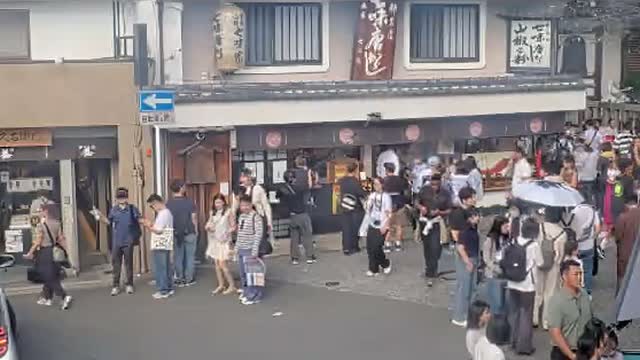
The crowd shows up in the traffic first
If you are heading for Kiyomizu-dera, look below the slope rather than at it. Higashioji-dori and Gojo-zaka is the junction at the foot of the hill, and both tour coaches and city buses turn here. On a day when the buses are backed up, that is the crowd about to walk up the slope.

The slope itself is on the Kiyomizu-zaka camera. Early in the day the stone paving is visible; as noon approaches the street fills with people. How much of the paving you can still see is the measure.
Two cameras you can compare
A few places are covered from two directions. These pairs are worth opening side by side.
- Fushimi Inari Taisha, main approach and the back approach — both lead to the same gate. When the main one is jammed, the back one may still be moving. The shrine never closes its gate, so people can be on screen late at night.
- Nene-no-michi, Higashiyama — it sits on the route between Kiyomizu-dera and Yasaka Shrine, so the crowds from both converge here. Even when one of them is quiet, this lane can be full.
- Kyoto Station bus stops and the Hachijo-guchi taxi rank — this is where people gather before scattering across the city. The length of the queue is an early sign of how busy the day will be.
Steering toward the empty side
For when you want to avoid the crush, here are the cameras that are quiet to begin with. All are well-known temples and shrines, but they sit away from the centre, and the difference in how many people appear on screen is obvious.
- Saga-Toriimoto preservation district — thatched roofs and townhouses along the approach to Atago Shrine. It is as far as you can walk from Arashiyama, and the figures thin out sharply.
- Oharano Shrine — an old shrine at the foot of the western hills, its approach running through woodland. The quiet under the trees lasts a long time.
- Jakko-in — a convent deep in the Ohara valley. It is far enough out and high enough up that on a snowy day this is the one place that turns white.
- Daikaku-ji — a wide precinct built around Osawa Pond. The grounds spread people out, so the crowding looks gentle.
Cameras with fixed hours
Not all thirty run the same way. Nishiki Market keeps to the shops' opening hours: the stream itself runs only from 11:00 to 18:00. Nothing at night is not a fault.
The opposite is also true. Hanami-koji in Gion lights up from early evening, and looks more like itself after dark. Part of the southern end is private property where entry and photography are restricted on site; watching on screen spares you that question.
The same frame, repainted by the season
On cameras where only the scenery changes, when you open them decides what you see.
| When | Camera | What happens |
|---|---|---|
| Late Feb–Mar | Jonangu | the weeping plums open and the approach visibly fills |
| Feb, and the 25th monthly | Kitano Tenmangu | plum blossom and the market day; exam season lengthens the queue |
| Late March | Zuishin-in | the only busy stretch is when the plum garden comes out |
| Spring and autumn | Daigo-ji | only the backdrop behind the halls changes, cherry to maple |
| Spring, early summer, autumn | Philosopher's Path | cherries leaning over the canal go from blossom to green to fallen leaves |
| Late November | Eikan-do | the temple famous for its maples turns colour all at once |
| Late November | Jingo-ji | when the Takao valley turns, the long stone stairway looks different |
| October | Heian Jingu | the Jidai Matsuri procession passes the great torii |
| Summer and winter | Kifune Shrine | summer brings people to the riverside platforms; in winter snow lies here and nowhere else |
Three separate operators
These thirty cameras do not come from one body. The temple gates and shrine approaches are run by the Kyoto National Highway Office, the city streets around Arashiyama, Gion and the station by the Kyoto City Tourism Association, and the three at Higashi Hongan-ji and Kyoto Tower by Mori Shinzaburo Shoho. Their purposes differ, and so does the character of the framing.
That is why some cards here carry no sample image. The highway office's cameras are covered by a public-data licence that lets us copy one frame, but the other two allow links freely and no reuse of the images, so we show no picture and provide only the way in to their own pages. How this site handles camera images has the details.
As scenery, Kyoto's cameras are unremarkable. But opening three or four before you leave — the slope, the bus stop, the back approach — is enough to decide where to go first. That is what they are good for.