Volcano
Mount Aso: 3 Live Cameras in Japan
An active volcano inside one of the world's great calderas. A still and a 4K live stream from Kusasenri, and Nekodake from the south — the monitoring eye and the scenic eye.
What you can see
There is no single mountain called Aso. The five peaks at the centre of an enormous caldera — Takadake, Nakadake, Nekodake, Kishimadake and Eboshidake — are known collectively as the Aso Five, and the one currently active is Nakadake.
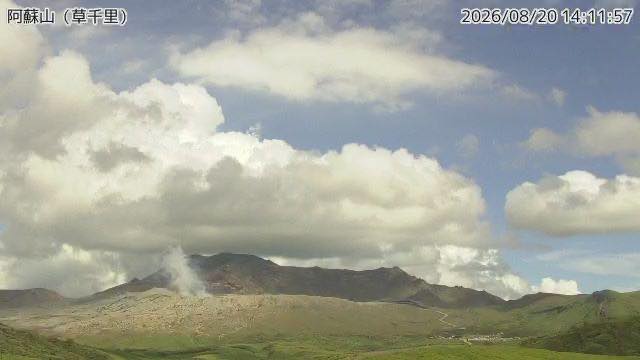
The Meteorological Agency's Kusasenri camera looks towards the crater from grassland to the west of Nakadake. Kusasenri is itself an old crater, so the frame holds the grass plain in front and the venting summit behind.
Nakadake and Kusasenri is a 4K live stream from that same viewpoint. The still is one frame every two minutes, which tells you how much is venting; which way the plume is going, and how fast, is something only moving video shows. It plays inside this page.
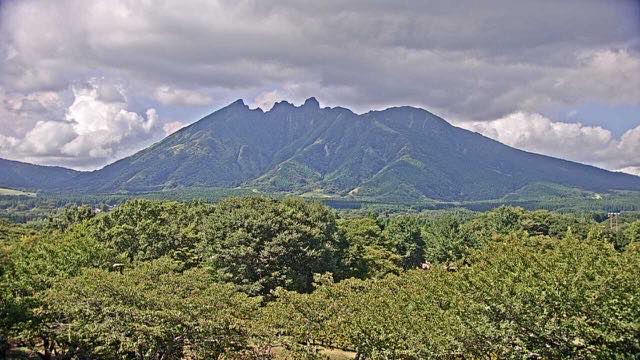
Nekodake seen from Minami-Aso is an Environment Ministry scenery camera. Nekodake is the jagged, saw-toothed rock peak at the eastern end of the Aso Five — an eroded old volcano, in pointed contrast to the active Nakadake. It is shot looking up from inside the caldera, where cloud comes and goes fast.
Cameras you can watch now: 3
1 video, 2 still. Tap one to open it in the camera list.
-
 Sample August 2026
Kusasenri, Mount Aso
Aso, Kumamoto · Volcano · Nature
Grassland in front of the Nakadake crater, sometimes with grazing horses. An unusual frame that holds both a volcanic plume and a meadow.
-
Live video
Mount Nakadake and Kusasenri, Aso
Aso, Kumamoto · Volcano · Nature
A panorama from the Kusasenri viewpoint that runs from the steaming crater of Nakadake across the grassland of Kusasenri-ga-hama. Volcano and pasture in one frame.
-
 Sample August 2026
Mount Nekodake from Minami-Aso
Minami-Aso, Kumamoto · Volcano
The jagged eastern peak of the five Aso mountains, seen looking up from inside the caldera. Cloud drapes and lifts off it all day.
When to watch
Inside the caldera, fog pools in the morning. On a clear autumn or winter dawn it can become a sea of cloud — spectacular from up on the caldera rim, but a blank white screen from a camera down inside it. To be sure of seeing something, come after 9 a.m., once it has burned off.
Through the year: the grass at Kusasenri greens up in May, and horses and cattle are put out to graze over summer. From late October into November it dies back to gold, and in winter it can take snow. Identical framing, completely different colour.
How much is venting varies enormously day to day — sometimes nothing, sometimes a white column standing over the crater. The Meteorological Agency still refreshes every two minutes, so leave it a while and come back to see movement; the 4K stream is already moving.
If it isn't showing
Two of the three are stills and go dark at night. The video stream keeps running after dark, but you cannot make out the crater in it. The Nekodake camera updates once an hour, so reopening it often gives you the same frame.
The still camera at Kusasenri exists to watch the volcano, not to compose a view; that so much grassland fits in the frame is the exception rather than the rule. The 4K stream covers the same Kusasenri as video, so you can either wait out the cloud on a still or simply watch.
All three also appear on the Kumamoto page. The other volcanoes of Kyushu are on Kuju and Tsurumi, Mount Unzen and The Kirishima range.
Where to find Mount Aso
Agencies publishing the cameras on this page
- Japan Meteorological Agency — volcano surveillance cameras (PDL 1.0) — Official site
- Ministry of the Environment — Internet Nature Institute (PDL 1.0) — Official site
- Nature Parks Foundation (Links free, no reuse) — Official site
The footage belongs to each agency. This site is an unofficial guide, and each sample frame was copied once per camera under that agency's terms of use.