Volcano
Okama, Mount Zao: 1 Live Camera in Japan
A crater lake whose water reads emerald green. It sits on the Miyagi–Yamagata border and refreshes every two minutes. In winter the road closes and the camera is all that is left.
What you can see
Okama is a lake in the crater of the Zao range. The water shifts from emerald green to milky white from one day to the next, which is why it is also called Goshiki-numa, the five-colour pond. It is strongly acidic with dissolved volcanic gas, and nothing lives in it.
The colour changes with the particles suspended in the water and the angle of the sun: bright green in the middle of a clear day, a dull grey-green under cloud. Watch the same camera for a few days running and the inconsistency is obvious.
It is one of the continuously monitored volcanoes, and the camera is there to watch for change around the crater.
Cameras you can watch now: 1
All 1 are still images. Tap one to open it in the camera list.
-
 Sample August 2026
Okama, Mount Zao
Miyagi / Yamagata border · Volcano · Nature
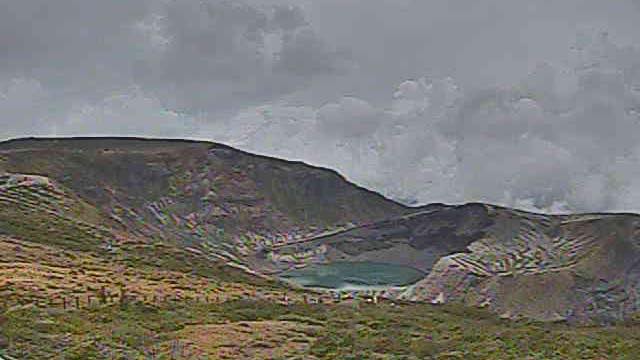
Okama sits small in the middle of the frame, beyond the ridge in front. The view is from the Katta side, so when cloud drops the green water disappears. Updated every two minutes by the Japan Meteorological Agency.
When to watch
The Zao Echo Line, which runs past Okama, closes for the winter — roughly November to April, you cannot get there. For those months this camera is effectively the only way to see it. A crater lake shut in by snow and ice is worth seeing precisely because you cannot go.
For the colour of the water at its best, a clear day between 10 a.m. and 2 p.m. The higher the sun, the further light reaches into the water and the more vivid the green.
Zao is also famous for its snow monsters, but those are on the ski-field side of the range and are not in this frame. Around Okama you are above the tree line, so what you get is rock and snow.
If it isn't showing
Okama is a crater lake on the Miyagi–Yamagata border, exactly where air from both sides meets. Clear at the foot with only the crater in cloud is a common outcome. It refreshes every two minutes, so leaving it and returning sometimes finds it cleared. From roughly November to April snow covers it and the colour of the water is not visible. Night hours show nothing either.
The same agency has eight cameras on The Volcanoes of Tohoku — Mount Kurikoma and Mount Chokai to the north, Mount Azuma and Mount Adatara to the south — which together show how far into Tohoku the cloud has reached. On the Fukushima side, Mount Bandai has two.
Where to find Okama, Mount Zao
Agencies publishing the cameras on this page
- Japan Meteorological Agency — volcano surveillance cameras (PDL 1.0) — Official site
The footage belongs to each agency. This site is an unofficial guide, and each sample frame was copied once per camera under that agency's terms of use.