Volcano
Kilauea: 1 Live Camera — Halemaumau Crater
A crater on Hawaii Island, carried live by the US Geological Survey. The eruption running since December 2024 comes in episodes, lava fountains days or weeks apart.
What you can see
Kilauea is a volcano at the southeast end of Hawaii Island. The camera belongs to the Hawaiian Volcano Observatory of the US Geological Survey (USGS), and it holds Halemaumau Crater in frame from the northwest rim of the caldera.
The eruption that began in December 2024 does not run continuously. Lava fountains come up every few days to few weeks, and in between the crater only smoulders. Expect that on most days you open it, nothing is happening.
Observatory staff change the aim and the zoom to follow the activity, so the framing is not the same from one day to the next.
The time stamp sits in the top-left corner and the provider's logo bottom-left. The figures along the bottom right, beginning P, T and Z, are the camera's pan, tilt and zoom, and they change when staff move it.
Cameras you can watch now: 1
All 1 are live video. Tap one to open it in the camera list.
-
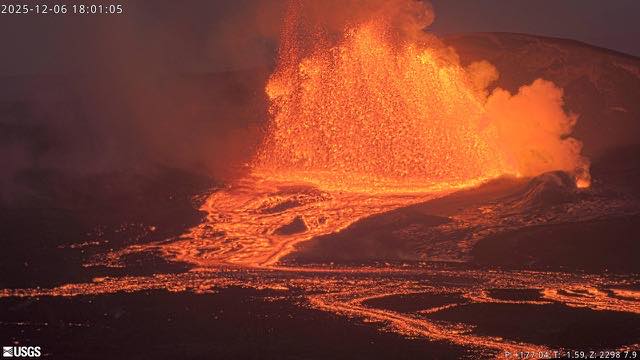 Sample December 2025
Kilauea, Halemaumau Crater
Hawaii Island · Volcano
A monitoring camera the Hawaiian Volcano Observatory keeps trained on the crater from the northwest caldera rim. The eruption that began in December 2024 is episodic: lava fountains every few days to few weeks, and a smouldering crater in between. Staff change the aim and zoom as activity shifts.
When to watch
It is live video, running around the clock, so there is no refresh to wait for.
The red of the lava reads more clearly the darker it is, which makes Hawaiian night the time to look. Hawaii is 19 hours behind Japan, so that is roughly 2 p.m. to 1 a.m. Japan time.
For the shape of the crater and the gas rising off it in daylight, open it during the Hawaiian day, about 1 a.m. to 1 p.m. Japan time. Daylight shows the ground clearly but washes the red out.
Hawaii Island is tropical and changes little through the year. What decides whether it is worth watching is not the season but the volcano, so the surest day to open it is a day an eruption has been reported.
If it isn't showing
For the Mauna Loa and national park cameras alongside it, The volcanoes of Hawaii Island, which sets out how the three differ.
Working out when a camera abroad is in daylight is covered in Which cameras are in daylight now, and every American camera is on United States.
Volcano cameras in Japan and abroad are all in Volcano, and what they are pointed at is written up in What volcano cameras are looking at.
Where to find Kilauea
Agencies publishing the cameras on this page
- U.S. Geological Survey (U.S. government work) — Official site
The footage belongs to each agency. This site is an unofficial guide, and each sample frame was copied once per camera under that agency's terms of use.