Sea
The Seto Inland Sea: 3 Live Cameras in Japan
Three cameras on the Inland Sea, from Okayama, Kagawa and Ehime. Layered islands, bridges, and running tide. They cross prefectures, so each prefecture page has only one.
What you can see
There are three cameras on the Inland Sea, but one each in Okayama, Kagawa and Ehime, so no prefecture page has the set. This is the page for seeing them side by side.
The Inland Sea from Washuzan (Kurashiki, Okayama) looks down from high ground on the Honshu side onto the Great Seto Bridge and the islands. Island silhouettes layer front to back — the classic Inland Sea composition.
The Inland Sea from Goshikidai (Sakaide, Kagawa) faces north from the Shikoku side. It is nearly opposite Washuzan, so the two are looking at the same water from either end.
The Kurushima Strait (Imabari, Ehime) is a different animal. This is one of the three great tidal races in Japan, and you can see streaks and whirlpools standing on the surface. The bridge above is the Kurushima-Kaikyo Bridge on the Shimanami Kaido.
The Inland Sea was one of Japan's first national parks, designated in 1934.
Cameras you can watch now: 3
All 3 are still images. Tap one to open it in the camera list.
-
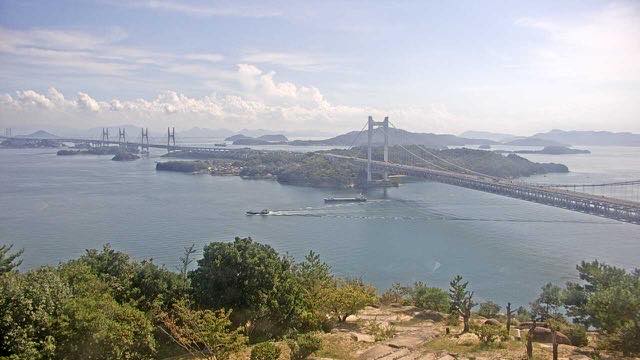 Sample August 2026
Seto Inland Sea from Mount Washu
Kurashiki, Okayama · Sea · Nature
A lookout known for its scatter of islands. The Great Seto Bridge overlaps the island silhouettes, and evening backlight sets the water shining.
-
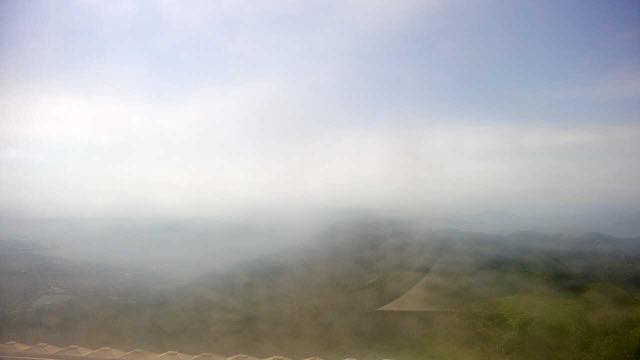 Sample August 2026
Seto Inland Sea from Goshikidai
Sakaide, Kagawa · Sea · Nature
The same sea from the Shikoku side. Facing the opposite way from the Washu camera, so the islands line up differently.
-
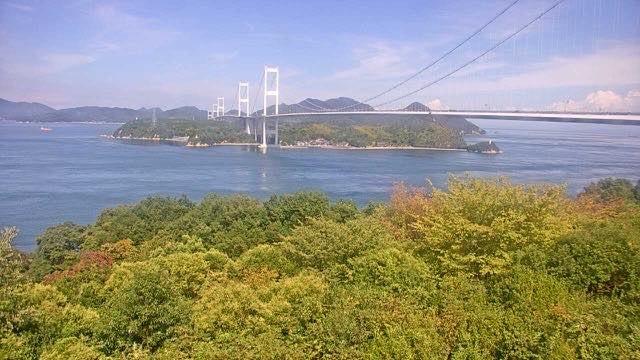 Sample August 2026
Kurushima Strait
Imabari, Ehime · Sea
One of Japan's three great tidal races. The pattern on the surface flips each time the tide turns, and large ships pass through in single file.
When to watch
The Inland Sea gets a lot of clear days and little wind. The trade-off is haze from spring into early summer, which softens the distant islands. For islands layered sharply front to back, come in autumn or winter, when the air is clean.
For time of day, late afternoon is the Inland Sea hour. Both Washuzan and Goshikidai face water to the west or southwest, so around sunset the surface lights up and the islands cut out black.
Kurushima alone runs on the tide. The current is fastest around the midpoint between high and low water on a spring tide, and that is when the streaks show. Open it at slack water and you get a calm sea, nothing more.
If it isn't showing
All three are stills that change once an hour, so there is no following the tide or a ship in real time. The eddies and streaks in the Kurushima Strait show up only when they happen to fall inside that one frame. None of the three shows anything at night.
The three sit one apiece in Okayama, Kagawa and Ehime. Of those only Ehime has a prefecture page — Okayama and Kagawa hold a single camera each, which is not enough to build one. This page is where the three come together.
Ehime also carries three live streams on the Hijikawa, next door to the strait: a sea moved by the moon and a river moved by dam gates, side by side. The other coastal cameras are on The Kuroshio Coast and Rivers and Coast in Hyogo.
Where to find The Seto Inland Sea
Agencies publishing the cameras on this page
- Ministry of the Environment — Internet Nature Institute (PDL 1.0) — Official site
The footage belongs to each agency. This site is an unofficial guide, and each sample frame was copied once per camera under that agency's terms of use.