Volcano
The Kirishima range: 2 Live Cameras in Japan
A volcanic group straddling Miyazaki and Kagoshima. One camera on Shinmoedake, one on the whole range from Ebino Kogen. Winter rime and early-summer azaleas swap the colour of the same slope.
What you can see
Kirishima is not one mountain but a cluster — Karakunidake, Shinmoedake, Takachihonomine and others. It crosses a prefectural border, so no single prefecture page holds both cameras.
The Meteorological Agency's Shinmoedake camera watches the crater that has been most active in recent years. There is a crater lake at the summit, and depending on activity it fills or dries out.
The Kirishima range from Ebino Kogen is an Environment Ministry scenery camera, looking across a plateau at around 1,200 m to the volcanoes beyond. The plateau in front and the peaks behind give it depth, and it is much the better of the two for watching the seasons.
Cameras you can watch now: 2
All 2 are still images. Tap one to open it in the camera list.
-
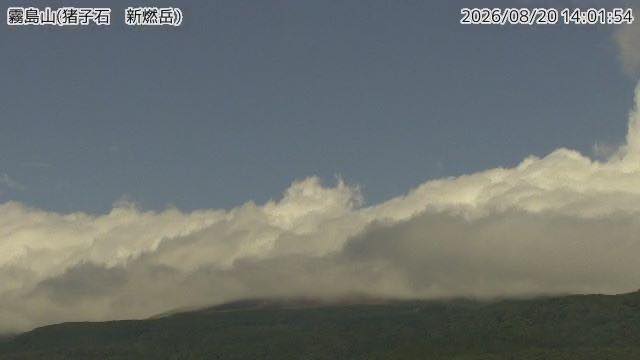 Sample August 2026
Shinmoedake, Kirishima
Miyazaki / Kagoshima border · Volcano
The crater that erupted in 2011 and 2018. The camera at Inokoishi stays fixed on Shinmoedake.
-
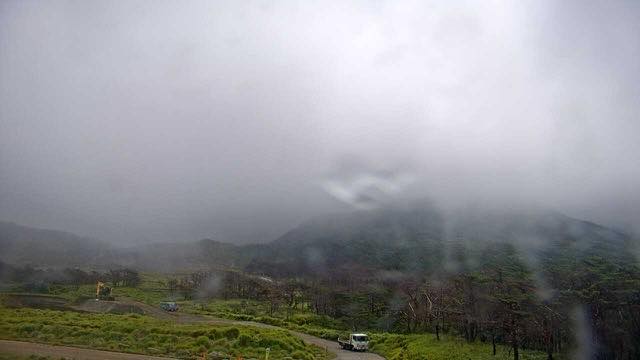 Sample August 2026
Kirishima Range from Ebino Plateau
Ebino, Miyazaki · Volcano
A group of volcanoes headed by Mount Karakuni, seen across the plateau. Rime ice coats everything in winter; azaleas colour the slopes in early summer.
When to watch
There are two clearly marked events a year.
The first is winter rime ice. Ebino Kogen is high, and on cold mornings from December to February the trees turn pure white. Rime drops off within an hour or two once the sun hits it, so open the camera between about 7 and 9 a.m.
The second is the Kyushu azaleas from late May into early June, when the slopes go pink. The flower is named for Kirishima and is what the range is known for. It coincides with the rainy season, though, so you need to pick a clear day.
Kirishima means 'island of fog', and it earns the name. Blank days are common, so do not give up after one look — try again at a different hour.
If it isn't showing
Kirishima means island of fog, and it earns the name. Both cameras are stills, neither shows anything at night, and even by day the mountain spends long stretches inside cloud — this is not a camera to give up on after one look. The Shinmoedake frame is fixed for monitoring; the Ebino Kogen one changes just once an hour.
The range straddles a prefectural border, so neither the Miyazaki nor the Kagoshima page holds both cameras. This is the only page that puts them side by side.
The same agency watches Sakurajima to the south, Mount Aso and Kuju and Tsurumi to the north, and Mount Unzen to the west. Weather moves separately over inland Kyushu and its coasts, so when this one is clouded in, somewhere else is clear.
Where to find The Kirishima range
Agencies publishing the cameras on this page
- Japan Meteorological Agency — volcano surveillance cameras (PDL 1.0) — Official site
- Ministry of the Environment — Internet Nature Institute (PDL 1.0) — Official site
The footage belongs to each agency. This site is an unofficial guide, and each sample frame was copied once per camera under that agency's terms of use.