Nature
Cherry Blossom: 5 Live Cameras in Japan
Cherry blossom moves south to north, low to high. These five cameras are ordered by when the bloom usually arrives, from Kamakura to Yoshino's Kamisenbon.
What you can see
This site carries five cameras on cherry blossom. The awkward part is that they are split across four prefectures — Kanagawa, Kyoto, Ishikawa and Nara — so no prefecture page has the full set. Same reason as the Mount Fuji page: hence this one.
They are not in map order. They are in the order the bloom normally reaches them. Cherry runs the opposite way from autumn colour: south to north, low to high. All five sit in central Honshu, so there is no country-wide spread here, but Kamakura and Kamisenbon are still more than two weeks apart.
None of the five was installed for the blossom. Yoshinoyama Kamisenbon belongs to the Ministry of the Environment and shows national park scenery. Kenrokuen belongs to Ishikawa Prefecture and shows the garden. The Philosopher's Path is run by the Kyoto City Tourism Association and Daigoji by the Kyoto National Highway Office of the transport ministry — both streaming so that people can walk at the uncrowded hours. Dankazura is the only one not from a public body: a Kamakura confectioner streams it from its own building on Wakamiya-oji.
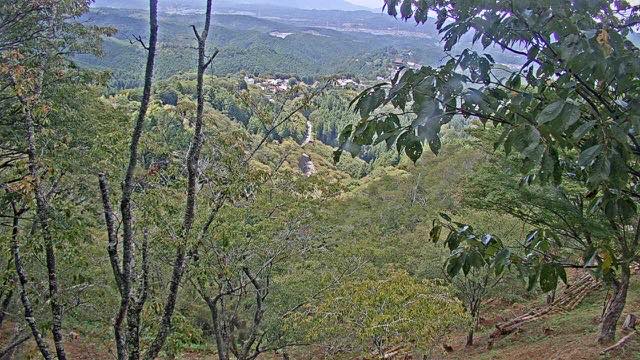
Only Kamisenbon fills the frame with blossom. The trees covering the hillside are mostly shiroyamazakura, the wild mountain cherry, and the mountain has four zones — Shimo, Naka, Kami and Oku-Senbon — that bloom upward from the foot. The camera is at the third of the four, so it comes a little after the news that Yoshino has opened.
On the other four the blossom is backdrop. The Philosopher's Path is a two-kilometre lane along a branch of the Lake Biwa Canal; its trees are called the Kansetsu cherries, after the painter Hashimoto Kansetsu, who gave Kyoto the somei-yoshino in thanks. Daigoji is where Toyotomi Hideyoshi held his cherry party of 1598, planting some 700 trees brought in from the surrounding provinces — 20 April in the modern calendar, well after Kyoto's average full bloom. Kenrokuen carries winter's rope cones and autumn colour in the same frame, and its kenrokuen-kikuzakura, with over 300 petals to a flower, opens from late April into late May, which gives this one camera the longest cherry season of the five.
Dankazura is a special case. In the rebuilding from October 2014 to March 2016, all 177 trees along the raised approach were replanted. They are still young, so there is no overhead tunnel of flower of the kind the photographs show. What the camera has is the years of branches reaching for it.
One more thing. Three of the Kyoto cameras are plum, not cherry. Kitano Tenmangu is February plum; Jonangu is weeping plum from late February into March; the plum garden at Zuishinin comes at the end of March. Open those looking for cherry and you are a month out. They are not on this page.
Cameras you can watch now: 5
4 video, 1 still. Tap one to open it in the camera list.
-
Live video
Dankazura, Tsurugaoka Hachimangu
Kamakura, Kanagawa · World Heritage · City
The raised walkway running down the middle of Wakamiya-oji. Cherry trees line both sides and a vermilion torii stands at the far end. The pavement on the right is the way up to the shrine.
-
Live video
The Philosopher's Path
Sakyo, Kyoto · Nature · World Heritage
The lane that runs south from Ginkaku-ji along a canal. Cherry trees lean their branches over the water: blossom in spring, green in early summer, fallen leaves drifting down the channel in autumn.
-
Live video
Daigo-ji temple
Fushimi, Kyoto · World Heritage
The grounds of the temple where Toyotomi Hideyoshi held his famous blossom viewing. Cherry in spring, colour in autumn: only the background to the halls is repainted by the season.
-
Live video
Kenrokuen garden
Kanazawa, Ishikawa · World Heritage · Nature
One of the three great daimyo gardens of Japan, seen from inside the grounds. In winter the yukitsuri ropes draw cones over the pines; in spring cherry blossom, in autumn colour, all in the same frame.
-
 Sample August 2026
Kamisenbon, Mount Yoshino
Yoshino, Nara · World Heritage · Nature
Part of a World Heritage site famous for cherry trees blanketing the hillside. Even out of season, the town in the valley and the layered ridges are worth it.
When to watch
The Meteorological Agency's average first-bloom dates for somei-yoshino (the 1991-2020 mean) at the stations nearest these five run like this. Yokohama 25 March (full bloom 1 April), Kyoto 26 March (4 April), Nara 28 March, Kanazawa 3 April (8 April). Roughly a week from opening to full bloom.
But two of the five are not measured by that calendar. Yoshino's cherries are shiroyamazakura rather than somei-yoshino, and the mountain climbs, so it blooms from the bottom upward through April; the Kamisenbon camera lags the foot of the hill. And the kenrokuen-kikuzakura opens only after the somei-yoshino have gone.
Morning is the time. Cherry is close to white, so the stronger the light the more it dissolves into the sky and the paving. Overcast does the same thing: against a white sky the flower nearly disappears. Blue sky, or a dark building or hillside behind it, reads far better.
The refresh pattern is the reverse of the autumn leaves page. Four of the five are live video, running around the clock. Only Yoshino is a still, refreshed hourly, so depending on when you open it you may be looking at a picture almost an hour old. The four video feeds keep moving after dark, but whether the flowers show depends on the street lighting and on whatever the place puts up.
For the falling, try about a week after full bloom, the day after wind or rain. The canal is in frame on the Philosopher's Path, so you can watch the petals going down the water.
If it isn't showing
Cherry season is also when the weather turns over fastest. Spring lows come every few days, and some years the full-bloom week is rain from end to end. The camera runs; what is in it is wet paving and umbrellas.
And the flower is on screen for less time than you would think. About two weeks from opening to bare, of which only a few days either side of full bloom actually look white. The rest of the year is the same place without blossom. Autumn Leaves and First Snowcap are the other two pages built around waiting for a season.
The four video feeds stop from time to time, at the provider's end. What is happening then is in what is happening when a live camera shows nothing.
Where to find Cherry Blossom
Agencies publishing the cameras on this page
- Ishikawa Prefecture, Parks and Green Spaces Division (Links free, no reuse) — Official site
- Kyoto City Tourism Association (Links free, no reuse) — Official site
- Kyoto National Highway Office, MLIT (PDL1.0) — Official site
- Ministry of the Environment — Internet Nature Institute (PDL 1.0) — Official site
- Toshimaya (Links free, no reuse) — Official site
The footage belongs to each agency. This site is an unofficial guide, and each sample frame was copied once per camera under that agency's terms of use.