Region
Ehime Live Cameras in Japan — 4 official webcams
The Kurushima Strait, one of the three fastest tidal currents in Japan, and three live streams following the Hijikawa from the dams upstream down to the castle town. A sea that runs with the tide and a river held back by gates, in one prefecture.
What you can see
One of the four is a still camera from the Ministry of the Environment; the other three are live streams from the Shikoku bureau of the transport ministry. All three hold one fixed point, so there is no cycle to wait through.
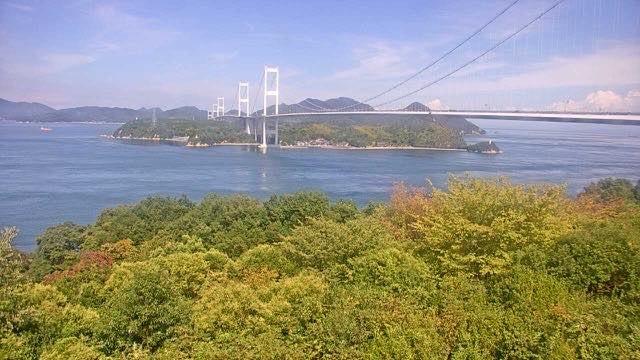
The Kurushima Strait is a narrow passage off Imabari, counted among the three fastest tidal currents in Japan. Every time the tide turns the surface changes pattern, and whirls and streaks show clearly. The channel is tight, so large ships pass through in single file. It is a still image that refreshes once an hour.
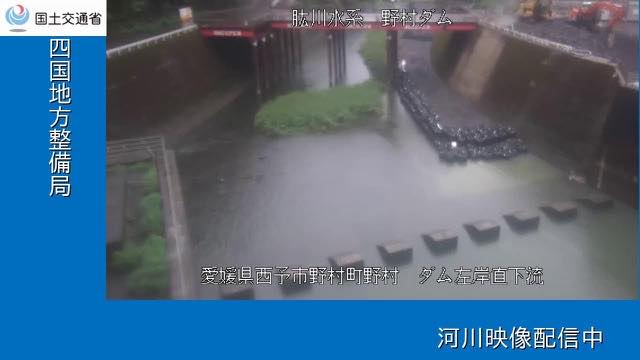
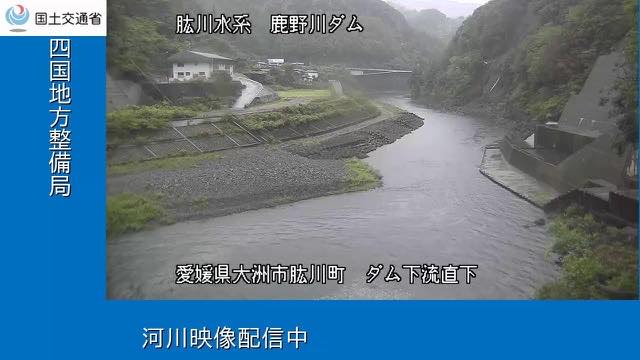
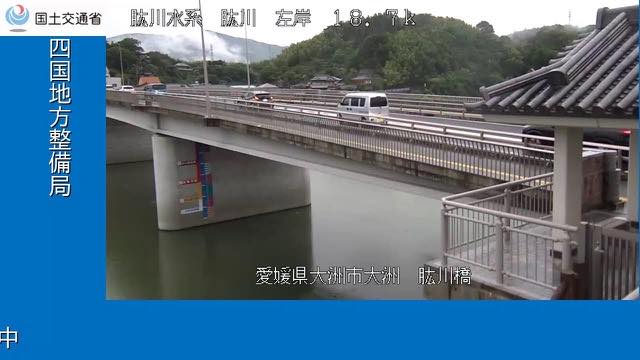
The three video streams take a single river, the Hijikawa, from the top down. Below the Nomura Dam sits just under the upstream dam on the left bank, where a release shows itself as it happens. The Kanogawa Dam outlet gate faces the mouth the middle dam discharges through, so you can read how much it is letting go without a number in front of you. Hijikawa Bridge crosses the river beside the castle town of Ozu, where the water gathered in the basin above passes on its way to the Iyo-nada sea.
These are the only two streams on this site that look straight into a dam's outlet. Open them alongside the strait camera and you can compare a flow the moon moves with a flow people decide at a gate.
4 cameras in Ehime
3 video, 1 still. Tap one to open it in the camera list.
-
 Sample September 2026
Kurushima Strait
Imabari, Ehime · Sea
One of Japan's three great tidal races. The pattern on the surface flips each time the tide turns, and large ships pass through in single file.
-
 Stream cover
Nomura Dam, just downstream
Seiyo, Ehime · River
Looking at the left bank immediately below Nomura Dam, on the upper Hijikawa. The camera holds this one spot, so a release can be followed from the moment it starts.
-
 Stream cover
Kanogawa Dam outlet gate
Ozu, Ehime · River
The outlet of Kanogawa Dam on the middle Hijikawa, seen head-on. How much the dam is passing is readable here without looking at any number.
-
 Stream cover
Hijikawa Bridge
Ozu, Ehime · River
A bridge over the Hijikawa beside the castle town of Ozu. Water gathered in the basin upstream passes here on its way to the Iyo Sea.
When to watch
What to watch at the Kurushima Strait is the turn of the tide. The direction changes four times a day, and the current runs fastest around the spring tides at full and new moon. The whirls and streaks show around those turns; at slack water it looks like an ordinary calm sea.
The three Hijikawa cameras move most from June to October, when the rainy front and the typhoons overlap. Rain on the hills upstream fills the dams, and when a release begins the Nomura and Kanogawa frames change first, with the level at Hijikawa Bridge following a little later.
Hijikawa Bridge is a place where fog forms on autumn and winter mornings. Ozu sits in a basin: air cooled overnight settles at the bottom, and mist off the water can cover the town. The morning after a clear, still day is the condition. When it happens, the bridge and the far bank go white and only the line of the river stays faintly.
Closer looks at cameras here
Agencies publishing the cameras on this page
- MLIT river live streams (Government Standard Terms 2.0) — Official site
- Ministry of the Environment — Internet Nature Institute (PDL 1.0) — Official site
The footage belongs to each agency. This site is an unofficial guide, and each sample frame was copied once per camera under that agency's terms of use.