Nature
Midnight Sun and Polar Night: 7 Live Cameras
Summer nights that never get dark, winter days that never get light. Four cameras inside the Arctic Circle, two just outside in Iceland, one far south.
What you can see
The Arctic Circle sits at 66°34′ north. North of that line the sun stays up for at least one full day in summer (the midnight sun) and stays down for at least one full day in winter (the polar night). Just north of the line that means a day or two a year; the further north you go, the more days you get. On a live camera the difference shows up as one simple thing: how bright the picture is.
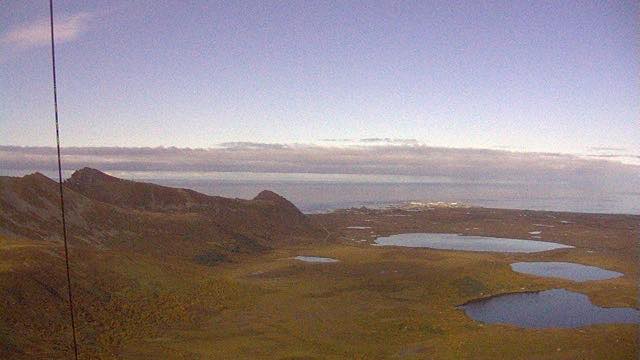
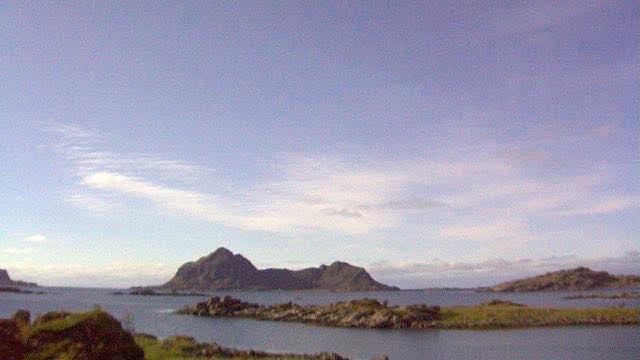
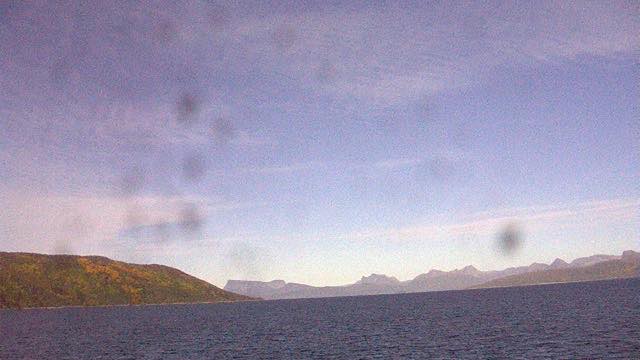
Four cameras inside the Circle. All four are observation points run by MET Norway, installed to measure weather rather than scenery. Trolltinden on Andøya sits at 69° north, on a mountain at the northern tip of the Vesterålen islands, facing west over treeless plateau, scattered ponds and the Norwegian Sea. Bø in Vesterålen looks out from a village on the open coast across islets and skerries. Drag in Hamarøy faces up Tysfjord towards the mountains at its head. Bjørnøya is at 74° north, an island halfway between the Norwegian mainland and Spitsbergen, with a weather station that has been staffed continuously since 1923. The whole island is a nature reserve, and fog is so common that the screen is often a flat white blank.
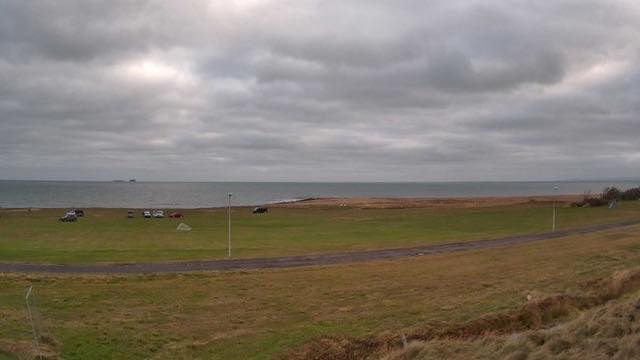
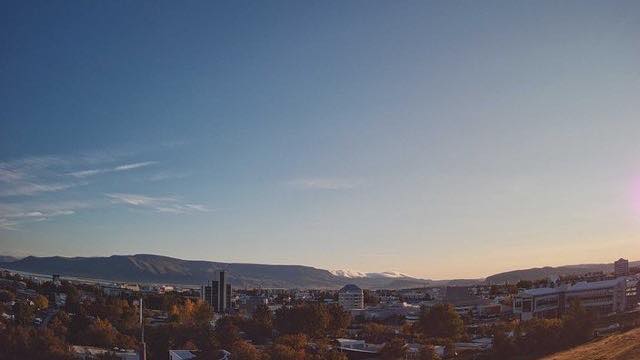
Two cameras just outside the Circle. Both belong to the Icelandic Met Office. Almost none of Iceland is inside the Arctic Circle — the line crosses only Grímsey, a small island off the north coast, and misses the mainland entirely. Mánárbakki is an observation point at a farm on the Tjörnes peninsula, which juts north into the Arctic Ocean; mown grass and a single road run out to the sea horizon. It is about as close to the line as mainland Iceland gets. Reykjavík is the Met Office pointing a camera north from the roof of its own building: city roofs in front, then Faxaflói bay, then the ridge of Esja on the far side.
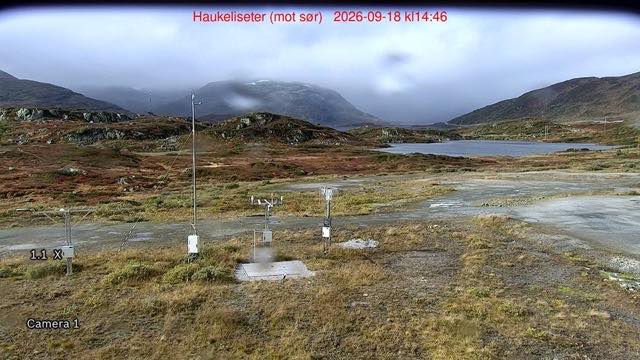
The seventh camera, Haukeliseter, is here for contrast. It is in southern Norway, on a 991 m mountain plateau, and it is a long way from the Arctic Circle. The posts and boxes filling the frame are all precipitation gauges: this is the field site where MET Norway works out how to measure snow correctly in wind. There is no midnight sun and no polar night here. Same institute, same kind of camera — and a completely different day and night.
These seven are grouped together because they let you see how far north you have to go before the night disappears. On a map the Nordic countries look like one block. Open all seven at the same moment and the brightness is different on every screen.
Cameras you can watch now: 7
All 7 are still images. Tap one to open it in the camera list.
-
 Sample September 2026
Trolltinden, Andøya, looking west
Andøya, Nordland · Nature · Sea
Looking west from a summit at 69 degrees north, on the island at the top end of Vesterålen. Treeless upland with small ponds scattered across it, and past them the horizon of the Norwegian Sea.
-
 Sample September 2026
Bø in Vesterålen, looking southeast
Bø, Nordland · Sea · Nature
From a settlement on the open-sea side of Vesterålen, out over water scattered with islands and skerries. Low rock and grass in front, then steep islands stacked behind one another.
-
 Sample September 2026
Drag, Hamarøy, looking northeast
Hamarøy, Nordland · Nature · Sea
From a village on Tysfjord, pointed up the fjord toward the mountains at its head. The far slope turns yellow in autumn. This is also a centre of Lule Sámi culture.
-
Still image
Bjørnøya, looking east
Bjørnøya, Svalbard · Nature · Sea
An island at 74 degrees north, halfway between the mainland and Spitsbergen. The station has been staffed by people measuring the weather since 1923, and the whole island is a nature reserve. Fog is common, and some days the frame is a single sheet of white.
-
 Sample September 2026
Mánárbakki, looking northeast
Tjörnes peninsula, northeast · Sea · Nature
An observation site at a farm on the Tjörnes peninsula, between Öxarfjörður and Skjálfandi. Mown grass and a single road, and beyond them the horizon of the Arctic Ocean.
-
 Sample September 2026
Reykjavík, looking north
Reykjavík · City · Sea
A camera on the roof of the Icelandic Meteorological Office's own building on Bústaðavegur, pointed north. City roofs in the foreground, then Faxaflói bay, with the ridge of Mount Esja along the far side.
-
 Sample September 2026
Haukeliseter, looking south
Vinje, Telemark · Nature
A test field for the institute's instruments, on a mountain plateau at 991 m. This is where they work out how to measure snow correctly in wind, so every post and box in the frame is a precipitation gauge. Lake Ståvatn and the ridges lie beyond.
When to watch
The dates depend on latitude. Computed from the sun’s declination: at Andøya, 69° north, the midnight sun runs roughly 27 May to 19 July (54 days) and the polar night roughly 28 November to 16 January (50 days). At Bjørnøya, 74° north, the midnight sun runs roughly 5 May to 9 August (97 days) and the polar night roughly 7 November to 5 February (91 days). (Calculated 2026-09-20, using the centre of the sun; published figures that allow for atmospheric refraction are slightly longer.) Neither happens at the two Icelandic cameras or at Haukeliseter.
Time zones decide when to look. Norway is UTC+2 in summer and UTC+1 in winter; Iceland stays on UTC all year and never changes. For the midnight sun, open them around local midnight in June — the four northern screens are still bright with the sun above the horizon.
For the polar night, open them around local noon in December. The four northern cameras stay in blue twilight even at midday, and the sun never rises. That twilight also gets shorter the further north you go. Open them at local night in winter and all you get is a black frame. Nothing is broken; it is simply dark there.
All seven are still-image cameras. The two Icelandic ones refresh every ten minutes.
If it isn't showing
The sources are MET Norway and the Icelandic Meteorological Office. There is no sample image for Bjørnøya — we have not yet captured a usable frame. How this site works and where the pictures come from explains the rule.
The nearest neighbour, in the sense of what a dark sky shows, is Aurora — with the opposite relationship, since the midnight sun is exactly when aurora cannot be seen. Other cameras from the Icelandic Met Office appear under Glaciers and Geothermal valleys and steam fields, and the seven here also appear on the Norway and Iceland pages.
What you see depends on the hour you open them, so the arithmetic is in Finding a camera that is in daylight right now. If the frame is black and you want to know whether it is night or a fault, see When a live camera shows nothing.
Where to find Midnight Sun and Polar Night
Agencies publishing the cameras on this page
- Icelandic Meteorological Office (Free to use with credit) — Official site
- Norwegian Meteorological Institute (NLOD / CC BY 4.0) — Official site
The footage belongs to each agency. This site is an unofficial guide, and each sample frame was copied once per camera under that agency's terms of use.