River
Iwabuchi Floodgate: 1 Live Camera in Japan
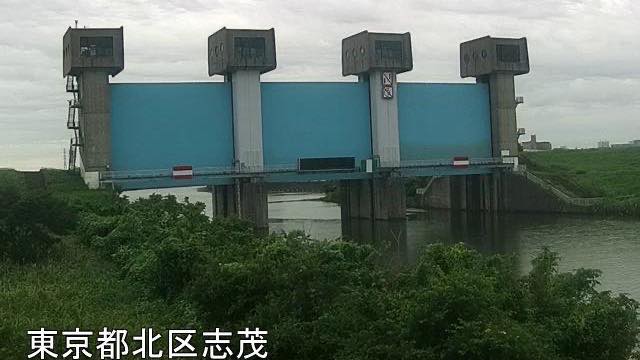
The gate where the Sumida River leaves the Arakawa. A transport ministry camera watches it from the Kita-ku bank, once a minute. Blue doors fill the middle.
What you can see
The Iwabuchi Floodgate stands at the point where the Sumida River separates from the Arakawa, 20.5 km from the river mouth. The camera is on the right bank, on the Shimo, Kita-ku side of Tokyo, and the blue doors run across the middle of the frame.
Below this point the Arakawa is not a natural river. It is the Arakawa Floodway, dug by hand between the end of the Meiji era and the start of the Showa era to send floodwater to the sea instead of through the city. That is why it runs straight and wide with high banks on both sides, and why the ground between the banks is used as sports fields and rough grass.
Of the ten Arakawa cameras on this site, this is the only one looking at the mouth of the floodway. The images carry the name of the place burned into the bottom-left corner — for this one, Shimo in Kita-ku, Tokyo. The operator is the Ministry of Land, Infrastructure and Transport's Lower Arakawa River Office.
The feed stops during works. If no picture comes up, leave it a while and open it again.
Cameras you can watch now: 1
All 1 are still images. Tap one to open it in the camera list.
-
 Sample August 2026
Iwabuchi Floodgate
Kita, Tokyo · River
20.5 km from the mouth. The floodgate where the Sumida River branches off the Arakawa, seen from the Shimo side in Kita ward on the right bank. The blue gates stand across the middle of the frame.
When to watch
It refreshes once a minute, among the shortest intervals on this site, so what you open is essentially now.
It earns its keep in heavy rain and typhoons. The wide flat ground you normally see goes under from the bottom up as the water rises, and you can read the situation from how far the fields and paths have gone under without reading a gauge. The worse the day, though, the darker the frame and the more rain sits on the lens. Decide about evacuating on what your local government says. This camera is for seeing how things look.
On a calm day, morning and evening work best. The river runs north to south, so the surface blows out white in the middle of the day and low light carries further across to the far bank.
Winter air is clear enough that the towers of central Tokyo line up beyond the bank on some days. On a summer evening you can see people out on the flats.
If it isn't showing
To follow the same river with ten cameras from upstream to the sea, The Arakawa — from Sasamebashi in Toda, Saitama, down to Shinsuna in Koto-ku where it reaches the sea.
Every river camera on the site, in Japan and abroad, is in Rivers, and reading a river in flood is written up in a separate piece.
Where to find Iwabuchi Floodgate
Agencies publishing the cameras on this page
- MLIT Arakawa Downstream River Office (PDL 1.0) — Official site
The footage belongs to each agency. This site is an unofficial guide, and each sample frame was copied once per camera under that agency's terms of use.