Live camera
Earth from the International Space Station live camera
The official feed from the external cameras. The station circles the Earth in roughly 90 minutes, so day and night swap about every 45 minutes. The sky artwork on the card is for ground cameras and does not apply here.
 Sample October 2026
What you are looking at
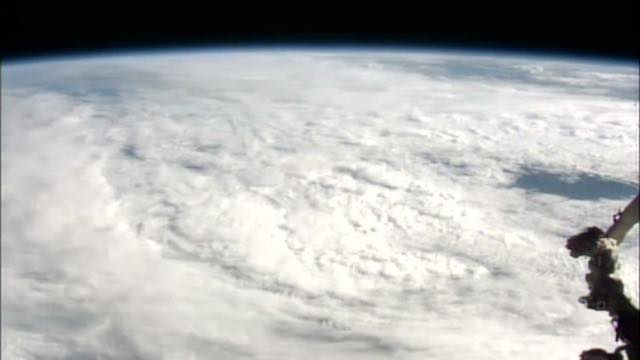
In the sample frame, black space fills the top of the picture and the curve of the Earth's edge runs across below it, the layer of air showing as a thin pale blue line along that edge. Lower down lies an almost unbroken field of cloud with a coiled mass near the middle. At the right edge are a white strut of the station and a piece of equipment wrapped in gold foil. No land is in the frame.
The camera is mounted outside the station. It circles at a height of between 370 and 460 km, and thin air drags it slowly downward, so the orbit is raised again from time to time.
That orbit is tilted 51.6 degrees from the equator, so the ground sliding past below the camera is limited to the band between 51.6 degrees north and 51.6 degrees south; the poles never pass directly underneath. Japan lies inside the band. Sea covers seven tenths of the planet and cloud covers much of that, so passes with land clearly in the frame are the exception rather than the rule.
The station measures 109 m from the tip of one solar array to the other and 51 m the other way, and its mass is over 400,000 kg. Since the first long-duration crew arrived on 2 November 2000 there has not been a day without people aboard.
A completely black picture means the station is on the night side of the Earth. If the picture turns a flat blue, or freezes on a fixed card, the link to the relay satellites has dropped for a while and will come back on its own.
This is live video, so the field of cloud is seen drifting past rather than stepping forward a frame at a time. Times shown on the feed are Coordinated Universal Time, nine hours behind Japan.
About this camera
| Place | about 400 km up |
| Format | Live video |
| Time zone | UTC |
| Category | Space |
| Operator | NASA |
| Terms of use | U.S. government work |
The operator's own page
The footage belongs to each agency. This site is an unofficial guide, and each sample frame was copied once per camera under that agency's terms of use.